
Fig.1

Fig.2
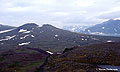
Fig.3
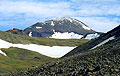
Fig.4

Fig.5

Fig.6

Fig.7
Sedanka lava field is located
immediately west of the Sredinny Range axis and is formed by dominantly
mafic lavas from small strato- and shield-like volcanoes and >100 cinder
and lava cones of the late Pleistocene-Holocene age (Figs. 1 and 2). The
lava field has an area of ~1500 km2. Holocene activity
includes Titila (GVP #1000-56, Fig. 3) and Gorny Institute (GVP #1000-55, Fig. 4) volcanoes as well as a number of cinder cones
including Terpuk (GVP # 1000-512, Fig. 5) and Sedankinsky (Fig. 6).
Sedanka lava field is located
north of the edge of the subducting Pacific Plate, that is beyond an
active subduction zone e.g. Gorbatov et al., 1997,
Levin et al., 2002, Park et al., 2002), so the origin of magmatism in
this area is unclear (Dirksen et al., 2004;
Volynets, 2006; Volynets et al., 2005, 2006). The investigation of melt
inclusions in Ol phenocrysts revealed the existence of two types of
parent melts in some samples: low-K tholeite and medium-K high-Ti
basalts. The presence of these melts suggests the mixing of different
parent melts during magma generation (Pletchov et al., 2003).
Detailed geological and
tephrochronological studies have permitted identification of three main
periods of volcanic activity within the Sedanka lava
field: late Pleistocene, when most of the stratovolcanoes were formed;
then 10-8 ka BP, and finally 3-2.5 ka BP (14C), when a number of large
cinder cones were formed and the last eruption from Titila volcano occurred.
Holocene soil-pyroclastic cover in the area
(Fig. 7) includes more than ten marker tephra layers. Most of these
tephras originated from Shiveluch volcano, located ~100 km to the
southeast. In addition, there are regional marker tephras
including KHG from Khangar volcano (6850 14C yr BP) and KS1 from Ksudach (1800 14C yr BP). These tephras have permitted reconstruction of local
eruptive activity.
Titila (57°24' N, 160° 07' E; Fig. 3) is a small
shield-like volcano. It started to form in the late Pleistocene time. The
volcano was active 10-8 and 3-2.5 ka BP (14C) (Dirksen et al., 2003,
2004). Titila eruptives
are transitional from medium to high-K basalt.
Gorny Institute volcano (57°20' N, 160°11' E; Fig. 4) is believed to have repeatedly erupted during the
Holocene (Pevzner, 2006). Sedankinsky lava flow (Fig. 6)
at the southern slope of the volcano was erupted ~6.2 ka BP (Pevzner,
2006).
Literature
Dirksen O. V., Bazanova L. I., and M. V.
Portnyagin (2003) Chronology of the Holocene volcanic activity in the
northern part of the Sredinny Range, Kamchatka (Sedanka Dol lava field).
Volcanism and Geodynamics. Abstracts of the II All-Russia Symposium on
Volcanology and Paleovolcanology (Ekaterinburg, 2003), pp. 871–874 [in
Russian].
Dirksen O.V., Bazanova L.I., Pletchov P.Yu., Portnyagin M.V., Bychkov K.A. (2004) Volcanic
activity at Sedankinsky Dol lava field, Sredinny Ridge, during the
Holocene (Kamchatka, Russia). Linkages among tectonics, seismicity, magma genesis, and eruption in
volcanic arcs. IV International Biennial Workshop on Subduction
Processes emphasizing the Japan-Kurile-Kamchatka- Aleutian Arcs.
Petropavlovsk-Kamchatsky. August 21-27, 2004, p. 55. http://www.kscnet.ru/ivs/conferences/kasp/tez/contents.htm
Ogorodov N. V., Kozhemyaka N. N., Vazheevskaya A. A., and A. Ogorodova
(1972) Volcanoes and Quaternary Volcanism in the Sredinnyi Ridge of
Kamchatka. Nauka, Moscow [in Russian]
Pevzner M.M. (2006) Holocene volcanism of Northern Kamchatka: The
spatiotemporal aspect. Doklady of the Russian Academy of Sciences, Earth
Sciences, Vol. 409A, No. 6, pp. 884–887. Original Russian text published
in Doklady Akademii Nauk, 2006, Vol. 409, No. 5, pp. 648–651.
Pletchov P.Yu., Bychkov K.A., Dirksen O.V., Ariskin A.A. (2003)
Study of melt inclusions in the olivines from basalts in the Terpuk
volcano region, Sredinny Range, Kamchatka. Abstracts, Moscow State
University. Siebert
L, and Simkin T (2002-). Volcanoes of the
World: an Illustrated Catalog of Holocene Volcanoes and their Eruptions.
Smithsonian Institution, Global Volcanism Program, Digital Information
Series, GVP-3, (http://www.volcano.si.edu/world/).
Volynets, A. O.
(2006), Pleistocene-Holocene volcanism of Sredinny Range, Kamchatka:
rock composition and geodynamic interpretation, Ph. D. thesis, Moscow
State University, 195 pp.(In Russian).
Volynets A.O., T.G. Churikova, and G. Wörner
(2005), Geochemistry of the volcanic rocks of
Sredinny Range, Kamchatka, Vestnik KRAUNC, Earth science series, 2(6),
21-33 http://www.kscnet.ru/kraesc/2005/2005_6/2005_6.html (In Russian).
Volynets
A., Woerner G., Churikova T., and P. Layer (2006), The source of
Pleistocene-Holocene volcanism in the Sredinny Range back arc,
Kamchatka: constraints from trace elements and isotopic compositions,
Abstracts of the 5th Biennial Workshop on Subduction Processes
emphasizing the Japan-Kurile-Kamchatka-Aleutian Arcs. Sapporo, Japan,
40-42.